Narrative Theory
The narrative is the story line in which has a start, middle and end. The narrative is important in a film as it helps the film flow better and not confuse the audience. When trying to find meaning within narrative there are a series of codes and conventions that needs to be considered, characters, connotations and denotations, genre and structure.Characters:
- Physique
- Main character
- Body language
- Facial expression
- Relationships
- Demographics (age, gender, ethnicity.)
Connotations and denotations:
- Setting
- Iconography
- Themes
- Costumes
Genre:
- Lighting
- Colour
- Sound
- Own set of conventions
Structure:
- Start, middle, end
Propp:
Propp was mainly interested in narrative folk tales. He believed that folk tales were about the same basic struggles, therefore, had the same characters.The characters were...
- Hero
- Villain
- Princess
- Her dad
- Doner
- Helper
- Dispatcher
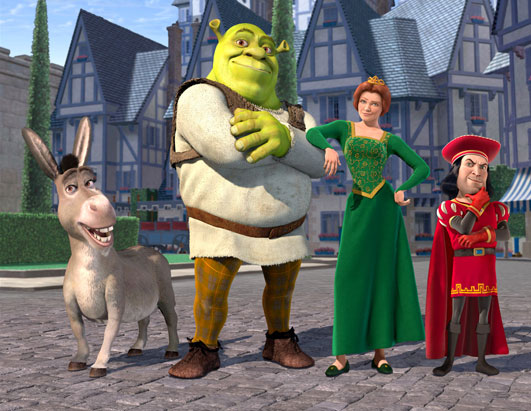
For example, in "Shrek", which is a narrative folk tale these characters exist. The hero being Shrek, villains being Lord Farquaad, Prince Charming and the Fairy Godmother, the princess being Princess Fiona, the father being King Harold.
Todorov:
Todorov believed that there is structure to a film which is a equilibrium (start), disequilibrium (middle) and new equilibrium (end).State of equilibrium

Recognition that the disorder has occurred
Attempt to repair the damage of the disruption
Return or restoration of new equilibrium.
Most films obey this structure such as "Orphan".
The state of equilibrium is clear when the protagonists want to adopt a child and happily find an orphan, Esther, which they choose to adopt. At this point everything is okay in the film. The next step is a disruption of that order by event in which happens when the mother suspects there might be problems with the orphan's background. The recognition that the disorder has occurred is when the mother Kate, realises that Esther tried to kill her son. The attempt to repair the damage of the disruption is when Kate gets the phone call explaining that Esther has hypopituitarism and rushes home to warn her husband. The return or restoration of new equilibrium is when Kate saves her children and kills Esther.
Aristotle:
Aristotle believed in having a beginning, middle and an end. The events must casually relate to one another, being necessary. He believes it is important to arouse emotion from the audience which is mainly within tragedy and believes it is important in evoking emotions through themes. Aristotle's theory applies to all genres, for example, in a comedy film the emotion that provokes the audience is laughter, in a romantic film the emotion that provokes the audience is sensitivity and happiness and in a thriller, the emotion that provokes the audience is anxiety and fright.
Barthes:
Barthes believed in having semiology within narrative. He believes that narrative can be defined by using the following things:
- Symbolic: Connotation (What you can infer) e.g. from looking at a knife you would infer danger.
- Semic: Denotation (The object that gives inference) e.g. the knife.
- Cultural Understanding: Events which can be recognised as being part of a culture.
I believe that thriller films tend to take Aristotle's theory as emotion is very significant to the genre. Without the evoking of emotions in a thriller it would lose its conventions and attract no audience.
Conclusion:
From looking at the different theories I will be including all four theories as they are all very important. It is important to stick to the structure, provoke emotions and set the characters right in order to maintain a clear narrative.

A good attempt here and all four theorist researched into. Clear that you understand how each can be applied to create meaning within the narrative.
ReplyDeleteTo improve;
-where you have mentioned the four ideas that can create meaning, be clear to state how each of the four you discuss provide the audience with a certain element of understanding the narrative. Introduce each convention with a sentence or two
-Propp: refer to the character that can apply to thriller films, for example The Princess is usually the female victim
-do thrillers just take on Aristotle? Look to analyse a scene like we did in class and apply the theories so you can see how you can, to a certain extent, apply all four.
-state how you will use all four in your work. Propps by including.....types of characters. Aristotle by using....themes and evoking....emotions.